Sille, a settlement with a history spanning five thousand years, has long maintained a strong cultural connection to İstanbul, despite the great distance between them. Today, it stands as a historic neighborhood in Konya’s Selçuklu district. The Aya Elenia Church in Sille was founded by Helena, the mother of Emperor Constantine, who declared İstanbul the capital of the Roman Empire.
Sille draws attention with its unique architecture and preserves a heritage that stretches from ancient times to the present — and even into the future. Positioned on the pilgrimage route from İstanbul to Jerusalem, Sille held significant importance during the Roman period.
Konya is home to Çatalhöyük, the world’s oldest known permanent settlement. Although Sille is not as ancient as Çatalhöyük, its five-thousand-year past and its rich cultural layers make it an equally remarkable place.
It is believed that the name “Sille” may be derived from “Sile” in Greek mythology. Another common view is that it comes from the Greek word silenos, meaning “running water.”
The population of Sille changed dramatically after the 1923 population exchange between Turkey and Greece. At the beginning of the 20th century, Sille had nearly 18,000 residents, most of whom were Greek. Following the exchange, they migrated to Greece, while Turkish families from Kozani and Florina settled in Sille in their place.
Hungarian researcher Béla Horváth visited the region shortly before World War I and wrote that there were around 60 churches in Sille at the time. Some of these were carved into the soft volcanic rocks of the area, while others were architecturally refined structures that have survived to the present day. During the Byzantine period, Sille became an important stop along the sacred route from Constantinople to Jerusalem. It evolved into a significant religious center for Christian travelers on their way to the Holy Land.
Helena, the mother of Emperor Constantine, is said to have rested in Sille during her pilgrimage from İstanbul to Jerusalem — an event that profoundly influenced the destiny of the region. She was impressed by the early Christian rock-carved chapels she encountered. In her honor, the Aya Elenia Church was built with local Sille stone and has undergone numerous restorations over its sixteen-century history.
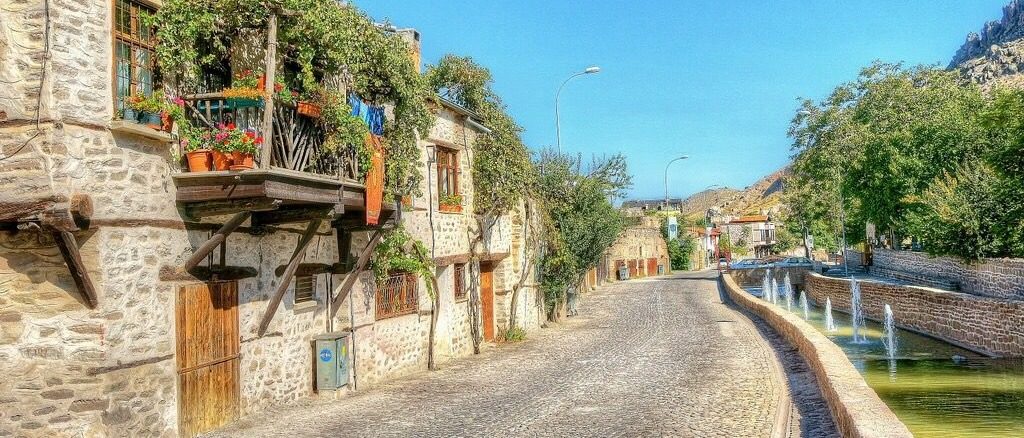
Throughout its past, Sille’s residents have been known for traditional crafts such as carpet weaving, pottery, viticulture, and stonemasonry. Today, its mosques, churches, and civil architectural structures are protected, and the harmony of Sille’s stone houses creates a distinctive historic atmosphere.
Visitors to Sille can explore Aya Elenia Church, the Devil’s Bridge, and its preserved historic streets. Whether for a day trip or a longer stay in one of the stone-house guest accommodations, Sille offers an unforgettable journey through layers of history.