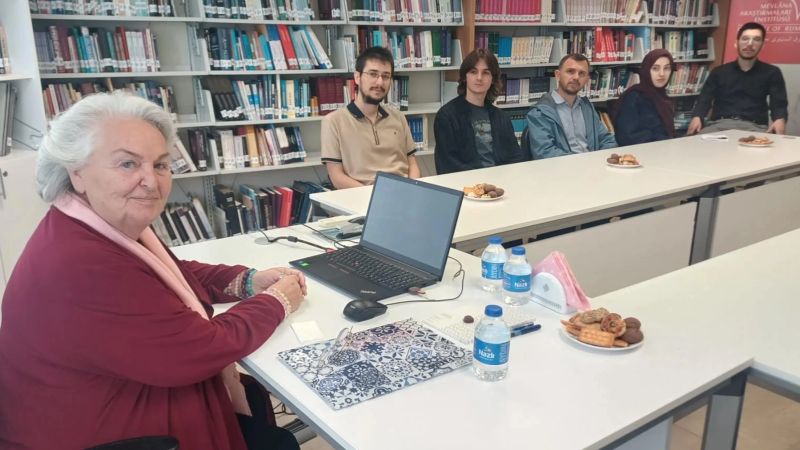

The site where Rumi and Shams met on November 30, 1244, features a monument called "Meracel Bahrain." Professor Dr. Ali Temizel, Director of the Mevlana Research Institute at Selcuk University (SU), stated that the meeting of Rumi and Shams-i Tabriz is referred to as "Meracel Bahrain," which translates to "the meeting of two seas."
Highlighting the significant role of Shams-i Tabriz in Rumi's life, Temizel remarked, “The two of them influenced each other profoundly, and their friendship began this way. Before meeting Shams, Rumi may not have composed poetry. He was primarily a preacher, a cleric, and a teacher. He had discussions and a following of students. He lectured on religion and morality in Konya. But after Shams arrived, a new fire ignited in him, for Shams was like the sun. Shams had a deep understanding of truth and spirituality, and Rumi, who already had a foundation for this, was drawn to spiritual love. His humanitarian beliefs and the education he received from his father laid the path for his spiritual journey. Rumi’s works include tales about the religious history of India and Iran, with artifacts that could serve as historical sources. These writings contain valuable historical, literary, aesthetic, and religious insights, reflecting both the times and the events they describe. Through his works, Rumi sought ways to connect with God.”
Temizel also shared that “Rumi’s friendship with Shams was envied by his students. As a result, they began to spread rumors about Shams. This caused various events that led to his eventual departure. Rumi’s son later brought him back, but the circumstances surrounding Shams’ second departure are unclear—whether he was killed or left voluntarily remains debated. Some sources suggest that if he had stayed, he might have been killed. Shams was never fully accepted by Mevlana's companions, which also impacted his prayers.”
Amazed by the profound knowledge he discovered in Shams, Rumi abandoned his teaching and mufti roles and embraced the path of a dervish, much like Shams.
Rumi expressed his reverence for Shams in one of his poems:
“Oh Shamsi (Sun) of God, if I see anything other than God in your pure mirror, I will be worse than an unbeliever” (Divan, p. 409). In this way, Rumi saw the divine presence in Shams, a truth he expressed on numerous occasions.
Sultan Veled, Rumi’s son, who knew Shams well, explained their meeting as similar to the encounter between Khidr and Moses in the Qur’an (18:60-82). While Moses' knowledge was worldly, Khidr’s knowledge came directly from God. The name "Khidr," meaning "green" in Arabic, signifies someone who imparts knowledge from God at every moment. Rumi found this divine wisdom in Shams and learned from him. After receiving the knowledge of ledun, Rumi turned away from worldly knowledge, embracing the eternal love of God:
“I am happy that I am now free of worldly happiness. I am drunk and happy without drinking wine;
If I’m not like anyone else,
Congratulations to this secret state of mine!” (Divan, p. 1426)
“My heart! When you became aware of the secrets, you freed yourself from all worldly affairs and became free.” (Divan, verse 58)
“Oh moon! You are the one who raises the fire in my heart. There are friends, but you are the one who burns my heart. People are happy with Nawruz and Eid, but you are both my Nawruz and my Eid.”
Shams & Rumi
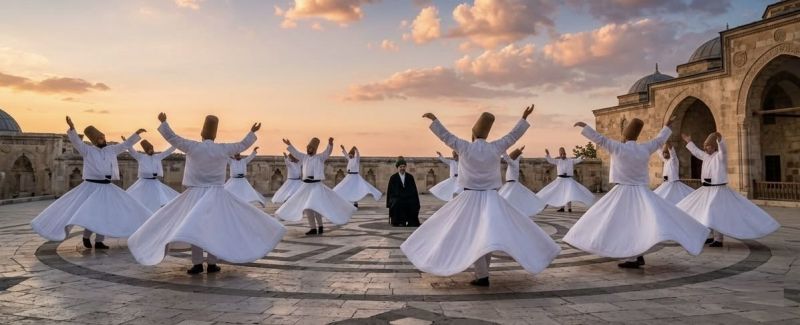
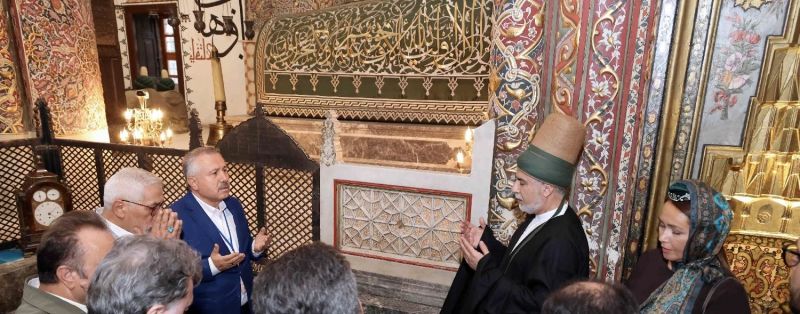
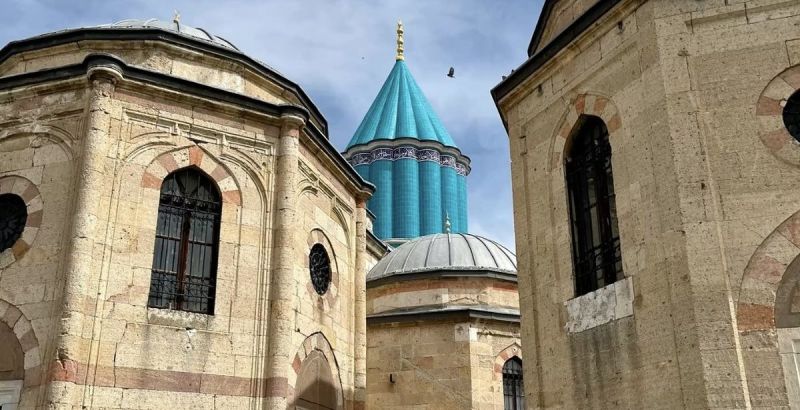
The mausoleum of Shams-i Tabriz in Konya, located in the Mevlana Museum, and the monument marking the spot where Rumi and Shams met on November 30, 1244, attract many visitors, particularly during the Seb-i Arus period. These locations hold significant importance in the life of Mevlana Celaleddin Rumi, the renowned Turkish-Islamic thinker, mystic, and founder of the Mevlevi Sufi order.
Born in Tabriz in 1185, Shams-i Tabriz, who lived until 1248, stands out as an Islamic scholar whose meeting with Rumi caused a profound transformation in the great thinker. Shams played a crucial role in Rumi’s spiritual development, guiding him towards divine love. Their three-year partnership deeply influenced Rumi’s poetry, resulting in the creation of the "Divan-ı Şems-i Tebrizi," a verse work of 44,834 couplets that explores themes of divine love.